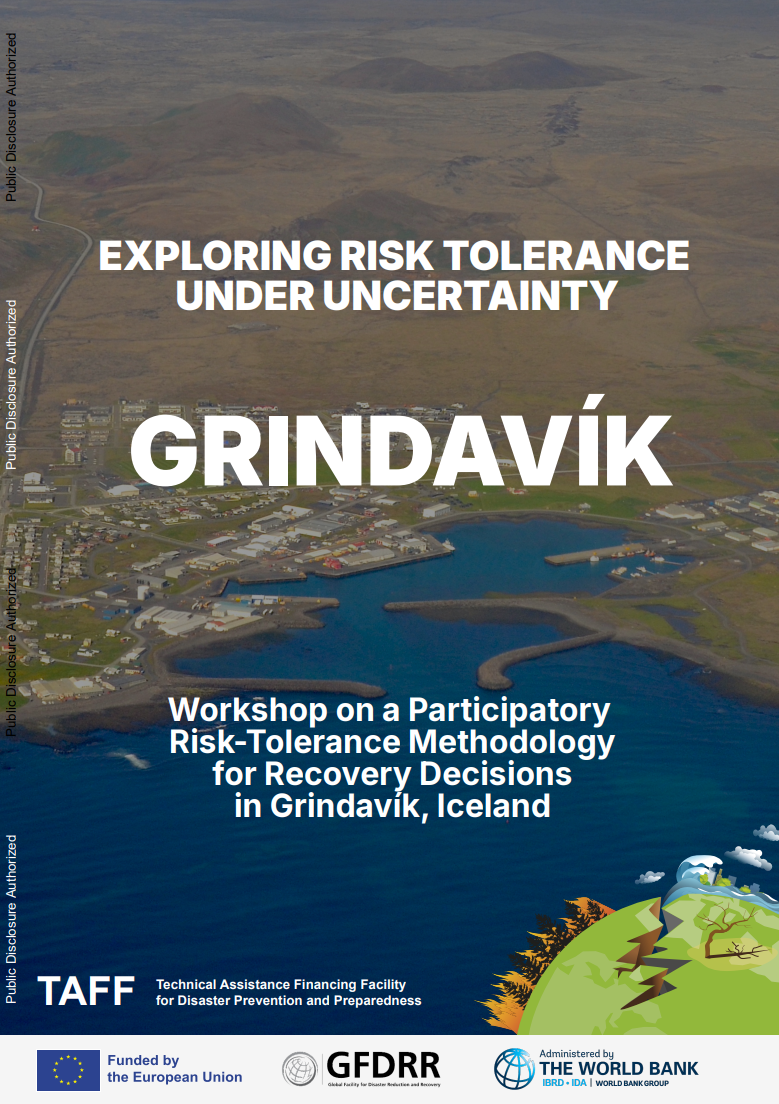
This report presents a participatory risk-tolerance methodology developed to support recovery decision-making in Grindavík, Iceland, following prolonged volcanic and seismic activity that began in 2023. The methodology addresses a critical gap between scientific risk assessment and policy decisions by defining the conditions under which residents, visitors, municipal services, and businesses can continue to operate under ongoing volcanic uncertainty. Through workshops involving government officials, emergency responders, businesses, service providers, and community representatives, participants established activity-specific risk-acceptance thresholds, non-negotiable safety conditions, and priority mitigation measures. The findings highlight the central importance of reliable warnings, evacuation capability, emergency-response readiness, effective communication, and public trust across all activities. Rather than determining whether Grindavík is simply safe or unsafe, the framework provides a transparent and adaptive process for evaluating acceptable, conditionally acceptable, and unacceptable levels of residual risk. The report offers practical guidance for integrating stakeholder perspectives into comprehensive risk assessments and supports more informed, accountable, and resilient recovery decisions in environments characterized by prolonged uncertainty.

Exploring Risk Tolerance Under Uncertainty : Workshop on a Participatory Risk-Tolerance Methodology for Recovery Decisions in Grindavík, Iceland
August 4, 2026