
The following is a summary of the final session of the Technical Workshop on Risk-Informed Urban Planning in Liberia hosted on June 17 to 19, 2026 by the government of Liberia and the World Bank, with financial support from GFDRR’s City Resilience Program.
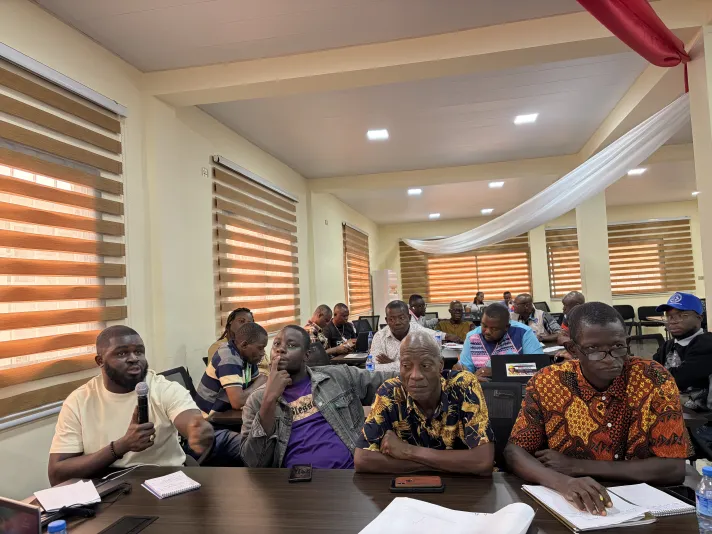
Day 3 of the technical workshop focused on operationalizing risk-informed urban planning through concrete instruments, implementation pathways, and institutional frameworks. The day was anchored by a technical presentation which introduced key planning instruments—including regulatory tools, financial and non-financial incentives, and enforcement mechanisms and their role in reducing risk and guiding safer urban development. This was complemented by a presentation from the Project Management Unit (PMU) on the Spatial Planning Project and Urban Planning Program with the University of Liberia, highlighting ongoing efforts to strengthen local capacity and institutional frameworks. The day concluded with group report-backs and a workshop wrap-up, where participants consolidated implementation priorities and translated earlier analytical work into actionable strategies. Overall, discussions reinforced key takeaways: the need for practical planning instruments, stronger institutional coordination, and sustained municipal capacity to support risk-informed urban planning and implementation.
Key Insights
From Planning Concepts to Operational Instruments
A central topic of Day 3 was the transition from conceptual frameworks to concrete planning instruments that can guide urban development decisions. The emphasizes was on how risk-informed urban planning relies on a combination of regulatory instruments, incentives, and knowledge systems that translate risk information into actionable rules and guidelines.
Participants discussed how developing zoning, land-use regulations, and building codes can help reduce exposure to hazards, prevent the creation of new risks. A key lesson from the discussion was that risk information alone does not change urban outcomes. Cities need practical instruments—including zoning, land-use regulations, and building codes—to translate risk information into investment, development, and enforcement decisions. and improve the resilience of infrastructure systems. These instruments must be supported by clear regulatory frameworks, operational guidance, and adaptation to local urban contexts, particularly in rapidly growing cities facing increasing risk exposure.
Co-Designing Municipal Instruments Under the New Zoning Framework
The five municipalities conducted a closing exercise to define instruments, implementation actions, and the next steps. The subsequent report-back sessions demonstrated how risk-informed planning approaches can be translated into concrete urban development strategies. Participants actively addressed how prioritizing safe locations, safe construction, and safe activities can foster and sustain resilient growth patterns.
The exercise demonstrated that addressing urban risk from unplanned expansion, informality, and environmental degradation requires a forward-looking approach. Participants committed to embedding spatial data, hazard mapping, and scenario analysis directly into planning decisions to ensure risk considerations are fully integrated. Moving from analysis to implementation, the groups co-designed actionable strategies to align land use, infrastructure investment, and risk reduction. These outcomes establish a clear roadmap for municipalities to transition from diagnosing vulnerabilities to enforcing resilient development on the ground. More broadly, the exercise showed that risk-informed planning becomes most effective when risk information is translated into concrete decisions on where to restrict, condition, or promote development.
This comes at a critical juncture for Liberian cities, as spatial planning processes have been launched in the secondary cities of Ganta, Gbarnga, and Buchanan, alongside plan implementation in Monrovia and Paynesville.
Institutional Coordination and Capacity as Core Enablers
Across sessions, participants identified institutional coordination and capacity constraints as key barriers to implementation. Responsibilities for planning, enforcement, and service delivery are distributed across multiple actors, requiring structured collaboration to ensure effective outcomes.
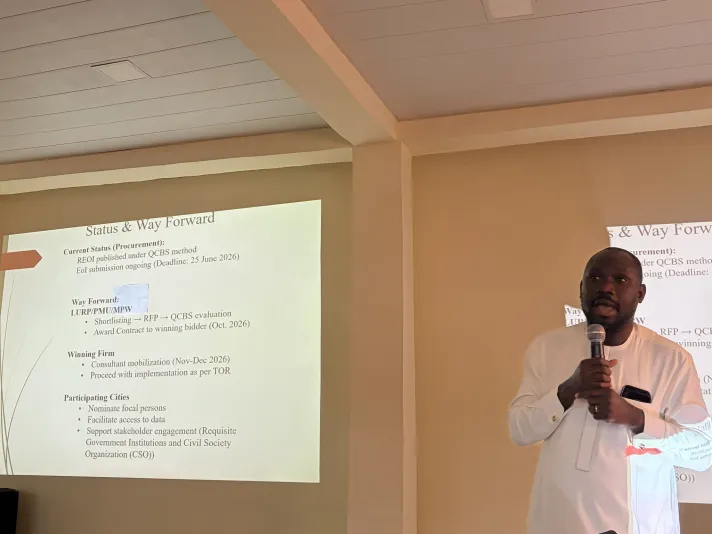
The presentation from the Project Management Unit of the Liberian Urban Resilience Project (LURP), highlighted ongoing efforts to strengthen institutional frameworks and enhance collaboration with the University of Liberia, particularly in building technical capacity and supporting planning processes.
Participants stressed that strengthening municipal capacity—through training, tools, and systems is essential for implementing risk-informed planning. This includes improving the use of Geographic Information Systems (GIS), enhancing monitoring systems, and developing the human resources required to manage urban growth and enforce regulations effectively.
“Planning is a practical tool to inform decisions; it does not need to be perfect for cities to start making better decisions today." - Santiago Ezequiel Arias, Senior Urban Specialist, World Bank
Lessons Learned and Next Steps
The workshop concluded with a synthesis of key priorities for advancing risk-informed urban planning and supporting implementation of the new Zoning Act in Liberia. Key next steps include developing implementation pathways at the city level, strengthening monitoring and compliance systems of implementation, and investing in technical capacity for planning and enforcement. Participants also emphasized the importance of sustained collaboration between national institutions, municipalities, and academic partners to support long-term implementation.
Overall, Day 3 reinforced that achieving resilient and livable cities requires proper risk informed unban planning and shift from planning to practice, supported by effective legal instruments, coordinated institutions, and continuous learning and adaptation.