The following is a summary of a session at the Emergency Preparedness & Response (EP&R) Learning Academy, which was hosted on April 20 to 24, 2026 by the World Bank Tokyo Disaster Risk Management (DRM) Hub, in partnership with GFDRR, and with financial support from the Government of Japan and the Government of Canada.
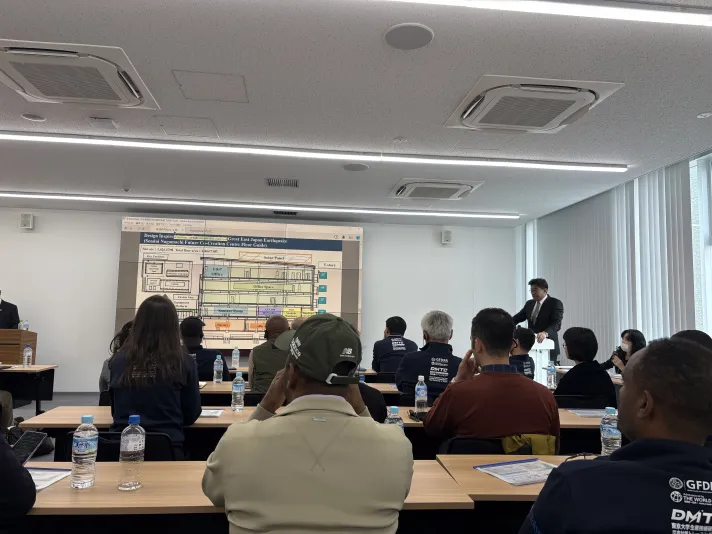
During the session titled "From Forecasts to Action: Lessons from Japan’s Integrated Early Warning and Disaster Coordination" participants learned about Japan’s approach to disaster risk reduction, with a focus on early warning systems. For example, participants learned that through the work of the Japan Meteorological Agency and several Ministries such as the Disaster Management Bureau and the Ministry of Land, Infrastructure, Transport and Tourism, Japan has developed a system that connects real-time observation, forecasting, warning issuance, and coordinated decision-making. Participants attending the EP&R Learning Academy were able to observe firsthand how advanced technologies, such as satellite monitoring, nationwide weather stations, and AI models providing forward-modelling forecasting, are embedded within clear legal frameworks and institutional roles. In Japan, an advanced alert system links risk information to public action, while a national data platform integrates inputs from many agencies across the country. The experience highlighted that effective early warning is not just about technical capacity, but about ensuring information is actionable, shared efficiently, and trusted. These elements provided transferable insights for countries at different stages of system development. As part of the Academy, participants also visited a 72-hour earthquake simulation exhibition, highlighting the critical window immediately following a major seismic event. This immersive component reinforced the importance of preparedness, rapid coordination, and timely decision-making in saving lives.
Key Insights
Early warning systems must link hazard information directly to decision-making and public action
The Japan Meteorological Agency demonstrated how forecasts are translated into clear, actionable guidance through Japan’s alert system. Participants were able to learn how each alert level is tied to specific actions, such as evacuation, reducing ambiguity for both authorities and the public. This was evident during heavy rainfall events, where real-time flood and landslide risk maps supported timely evacuation decisions by local governments. A key takeaway for participants was the importance of designing warning systems that go beyond technical accuracy - ensuring that risk information is simple, actionable, and directly linked to decision-making processes at all levels.
Integrated data platforms enhance coordination and enable faster, more proportional disaster response
Discussants highlighted how Japanese authorities have built a centralized platform that aggregates disaster and hazard information across agencies. Participants could observe how pre-defined, decision-relevant data is visualized through dashboards and maps to support national coordination. During an offshore earthquake of magnitude 7+ off the coast of northeast Japan that occurred during the EP&R Academy, this system enabled rapid assessment, showing no casualties, allowing authorities to calibrate their response appropriately. For visiting countries, a key lesson was to prioritize usability and relevance when developing data systems - starting with a central platform and clearly defining what information is essential for decision-making. A participant asking how countries starting from a limited EWS system should design such systems was advised to begin by building a central data receiving and aggregation platform first, rather than creating multiple disconnected systems that would later require complex integration. The response also emphasized the importance of defining in advance what constitutes “essential” information for decision-making. For visiting countries, this reinforced the lesson that usability, simplicity, and relevance should guide system design from the outset.
Lesson Learned
For visiting participants, Japan’s experience underscores the value of institutionalization: clear legal mandates, defined roles, and sustained investment are as important as technology. Countries can start small - by defining essential information needs, linking alerts to action, and building centralized data-sharing mechanisms. Strengthening trust, usability, and coordination across agencies will be critical next steps to ensure early warning systems translate into effective disaster response.