
Building on the conceptual foundations of Day 1, Day 2 of the Technical Workshop on Risk-Informed Urban Planning in Liberia focused on how to translate risk information into concrete urban planning decisions. Sessions explored Liberia’s zoning context, the spatial planning process, and the fundamentals of understanding urban risk—including hazard, exposure, and vulnerability.
Participants examined how development choices can increase or reduce risk and were introduced to practical tools for integrating risk into planning. Through interactive exercises, participants used spatial data and risk overlays to identify priority areas and test different planning scenarios.
The day emphasized moving beyond diagnostics toward actionable decision-making, equipping participants with practical approaches to guide safer and more resilient urban growth.
Key Insights
Risk is shaped by development decisions
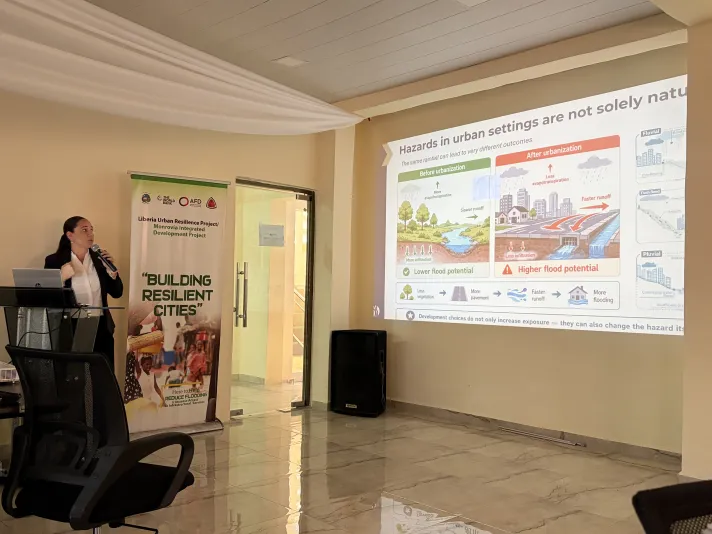
A key message was that risk is shaped by development decisions. As discussed in the urban risk session, risk results from the interaction between hazard, exposure, and vulnerability—and can increase when urban growth occurs in hazard-prone areas without adequate controls.
Participants explored how spatial patterns—such as settlement expansion into floodplains—can significantly increase risk if not managed appropriately. This highlighted the importance of using risk information early in planning processes to guide land use and infrastructure decisions.
The session reinforced that risk is not static, but evolves with development choices.
The value of the Restrict-Condition-Promote (RCP) framework
The Restrict–Condition–Promote (RCP) framework emerged as a key tool to link analysis to decision-making.
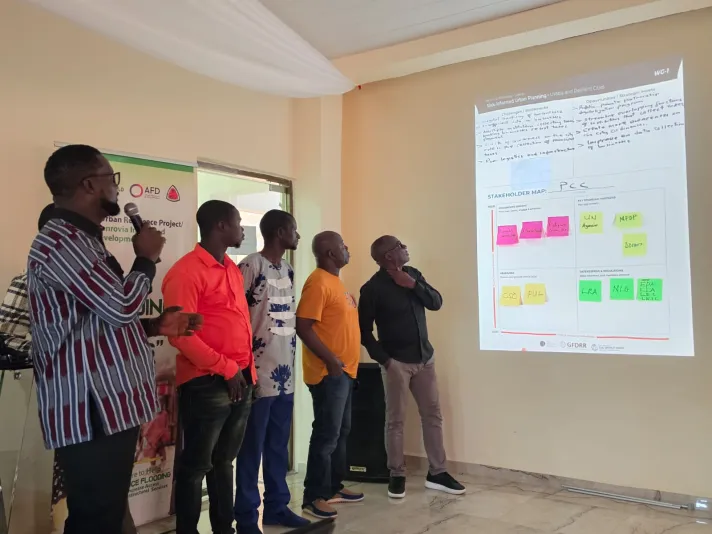
Through group exercises, participants applied the framework to real and hypothetical cases, identifying where development should be restricted due to high risk, conditioned with mitigation measures, or promoted in safer areas. For example, flood-prone zones were identified for development restrictions, while lower-risk areas were considered for future growth.
This exercise demonstrated how risk-informed planning can support more transparent and structured decision-making across sectors.
Lessons Learned and Next Steps
Day 2 strengthened participants’ ability to apply risk data to planning decisions. The importance of linking diagnosis with clear decision frameworks was emphasized. Moving forward, participants will build on these insights to define implementation pathways, focusing on institutional roles, financing, and enforcement mechanisms.