
For Solomon Islands, transport infrastructure is vital to not only connecting the country’s nearly 1,000 islands, but also linking people and businesses with markets, services, and jobs with the rest of the world. In a remote archipelago where distance can limit economic opportunity, reliable transport is central to inclusive growth and long-term resilience. Accordingly, Solomon Islands’ development strategy recognizes that transport infrastructure is key to unlocking the country’s sustainable development for the long-term.
While the government has made concerted investments in the country’s transport sector, much of the key infrastructure, such as roads, ports and airports, continues to suffer from quality issues, including inadequate maintenance. According to some estimates, as little as 15 percent of the road network is in fair to good condition. Critically, in a small island developing state located in the Pacific, transport infrastructure is vulnerable to climate change and natural hazards such as earthquakes, tsunamis, and regional volcanic activity.
In response, the government of Solomon Islands partnered with the World Bank to strengthen the resilience of the country’s transport infrastructure, with a focus on roads and aviation. This partnership, undertaken through the Solomon Islands Roads and Aviation Project (2019-24), or SIRAP, represented the Bank’s first engagement in the country’s transport sector since the 1980s.
Technical assistance from the Global Facility for Disaster Reduction and Recovery (GFDRR) informed the implementation of the project, particularly with regard to climate resilience upgrades to the country’s road network infrastructure. Under the project, support was provided to replace three critical bridges in Malaita Province, ensuring that the new bridges could better withstand severe weather. The new bridges have provided easier and more reliable access to markets, health and education facilities for local communities.
“SIRAP is a flagship investment for the Solomon Islands Government that directly supports our transport sector and wider economic goals. The SIRAP investments have made the Malaita roads and bridges safer and more climate resilient, significantly enhancing connectivity and boosting economic activities.
The Munda International Airport runway upgrade and new terminal building is providing opportunities for tourism, trade and business in Western Province, whilst also providing an alternative emergency international airport to Honiara.” - Mckinnie Dentana, Permanent Secretary, Ministry of Finance and Treasury, Solomon Islands
In addition to the new bridges, support under the project was also provided to routine maintenance, grading, and regravelling for 38 kilometers of roads in Malaita Province. This support helped ensure that the roads were in good or fair condition as of the closure of the project in December 2024. The routine maintenance works for the roads generated 950 person-days of local employment over the course of the project.
The Solomon Islands Roads and Aviation Project also paved the way for upgrades to the Munda International Airport in Western Province. Investments in a new international and domestic terminal building, along with upgrades to enhance the climate resilience of the runway, taxiway, and apron at Munda Airport enabled the resumption of the airport’s only international route. Prior to the upgrades, the existing pavement at the airport had not been suitable for regular jet flights.
The reopening of international flights to Munda has provided Solomon Islands with an alternative international point of entry to Honiara International Airport which has previously seen disruption due to extreme weather events. In the medium to long-term, the resumption of international flights to Munda has created opportunities for tourism, trade, and business.
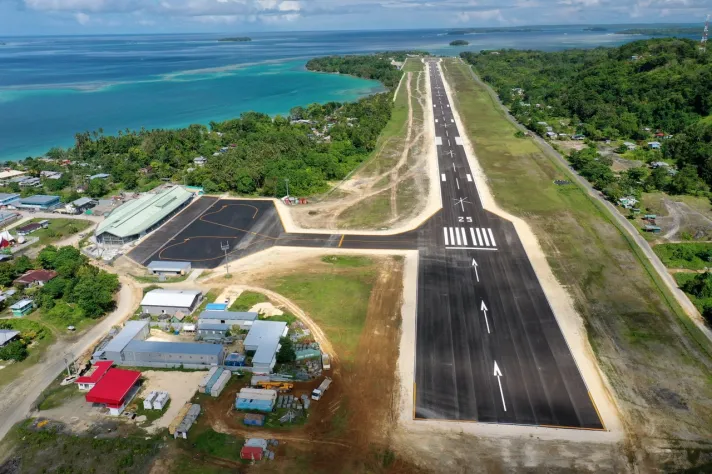
SIRAP also supported upgrades to the Munda International Airport. Photo Credit: World Bank
With an eye toward the long-term sustainability of these improvements, support under the project was also provided toward institutional strengthening and capacity building of the Ministry of Communication and Aviation and the Ministry of Infrastructure Development, both of which play key roles in managing the country’s transport infrastructure. The Quality Infrastructure Investment (QII) Partnership, a collaborative initiative between the World Bank and the government of Japan, supported these efforts. A previous QII-funded assessment of prefabricated bridges informed the Ministry of Infrastructure Development’s decision to build modular bridges in Malaita Province under the project.
Building on these milestones, the Second Solomon Islands Roads and Aviation Project (2022-present) is now further strengthening the resilience of the country’s roads and airports. By 2029, the World Bank-financed project is expected to help deliver three airport or airfield runways with resilience and safety measures, including in Honiara. This is in addition to the construction of four resilient bridges and 33 kilometers of resilient roads in Malaita Province.
The Second Solomon Islands Roads and Aviation Project, much like its predecessor project, was also informed by GFDRR technical assistance. Specifically, a $1 million grant from the GFDRR Japan–World Bank Program for Mainstreaming Disaster Risk Management supported the development of a strategy to strengthen the resilience of the road system, in addition to an assessment of the criticality and vulnerability of road assets.