
From cyclones and floods in Bangladesh to landslides in Bhutan, hurricanes and storms in the Dominican Republic, and typhoons in Vietnam, natural hazards are putting power systems under growing strain. The impacts differ by country, but the challenge is shared: how can power systems be built to withstand shocks, limit outages, and recover quickly?
Japan has a long history of facing earthquakes, typhoons, floods, and other natural hazards, and has drawn on these experiences to strengthen the resilience and reliability of its power sector. In May 2026, 16 energy professionals from Bangladesh, Bhutan, the Dominican Republic, and Vietnam visited Japan for a five-day Technical Knowledge Exchange on Power System Resilience and Asset Management. Organized by the World Bank with support from the Global Facility for Disaster Reduction and Recovery and the Japan-World Bank Program for Mainstreaming Disaster Risk Management in Developing Countries, the exchange offered a firsthand look at how Japan manages disaster risk, protects critical energy infrastructure, and plans for faster recovery.
“[In Japan,] resilience seems like something cultural, something inherent to daily life. You realize that it is a culture designed to manage itself within environments of change.” - Mercedes Alexandra Arias Dominguez, Director of Strategic Planning, Empresa Distribuidora de Electricidad del Este, Dominican Republic
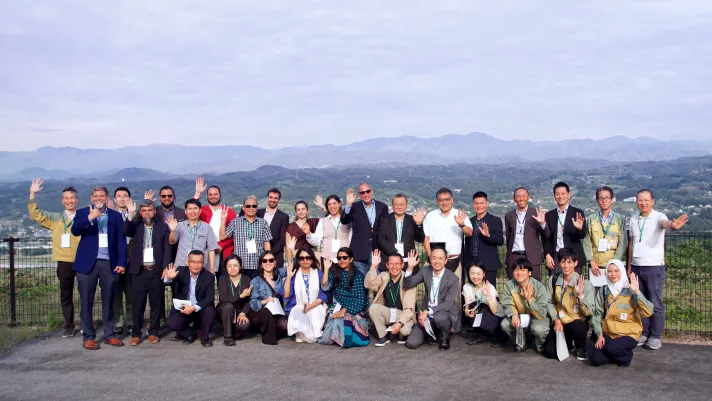
Participants visit the Iida City microgrid facilities, hosted by Chubu Electric Power Co., Inc. and Iida City. Photo: World Bank
Resilience Is Institutional
A central lesson from Japan was that resilience is not built through technology alone. Professor Hiroaki Nagayama of Kyoto University opened the exchange by tracing how Japan's power sector has strengthened its resilience over decades through a cycle of disaster, post-disaster assessments and risk analysis, learning, and reform. Recent disasters, including the 2018 earthquake in Hokkaido and major typhoons, have helped shape new legislation requiring improved standards and more coordinated disaster response across utilities, local governments, and national institutions. One delegate noted that even the best equipment can sit idle without policy support and leadership.
Tuan Anh Pham, Director, National Power Transmission Corporation, Vietnam, pointed to Japan’s strong coordination across institutions: “There is a very good relationship between the Japanese companies, utilities, local authorities, and the government to bring very good solutions for society.”
For Dawa Chhoedron, Chief Engineer, Department of Energy, Ministry of Energy and Natural Resources, Bhutan, the broader lesson was Japan’s discipline of turning experience into action: “With every disaster, there was a learning that was not only felt and noticed and noted, but actions were taken on that, and then more resilient planning was deployed [in Japan].”
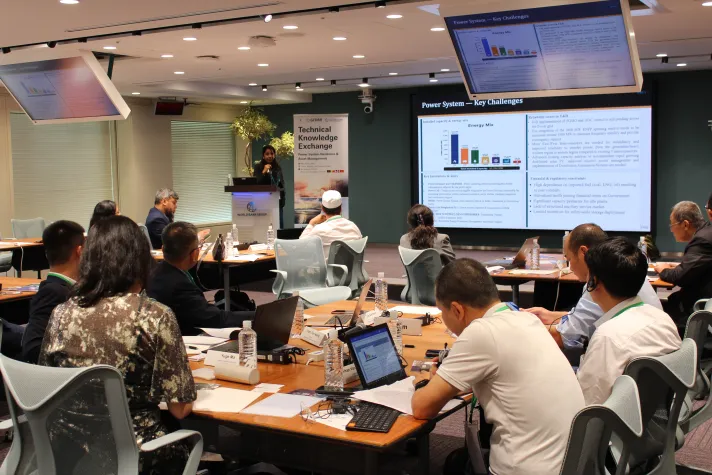
Each country delegation made a presentation on its power system status, disasters, and what they wanted to learn in Japan at the World Bank Tokyo office on Day 1. Photo: World Bank
Lessons from Japan’s disaster response experience were reinforced duringa site visit in Nagoya, where participants learned how truck-mounted mobile substations can speed up emergency restoration. The technology was put to the test in 2019, when Typhoon Hagibis flooded the Toyono substation in Nagano Prefecture. Mobile substations helped restore power in 39 hours, compared with 209 hours for conventional repairs.
“The mobile substation concept would be nicer if we can introduce this in our country, so that the restoration process, whenever there is an emergency, becomes easier.” - Fatema Tuz Zohra, Power Grid Bangladesh PLC, Bangladesh
At the 154kV Kansei substation, participants saw how Chubu Electric Power Grid uses drones and AI to make transmission line inspections faster and safer. Although rain prevented a live outdoor demonstration, engineers showed in a video how inspections that once required five workers climbing a 60-meter tower for four hours can now be carried out by two operators on the ground in about 40 minutes. For the participants, the example showed how practical technology can reduce risks for workers and help detect equipment problems earlier. The system used commercial drones and co-developed software, suggesting it could be adapted in their own countries.
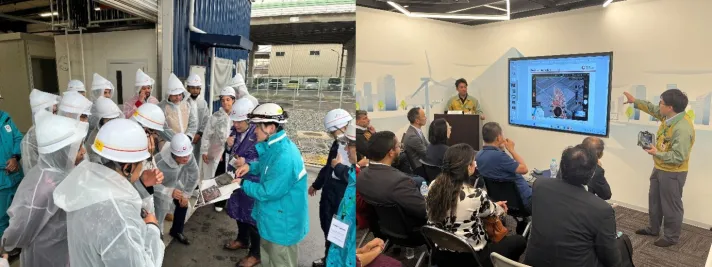
Participants visited Kansei substation on Day 4. Photo: Chubu Electric Power Grid Co., Inc.
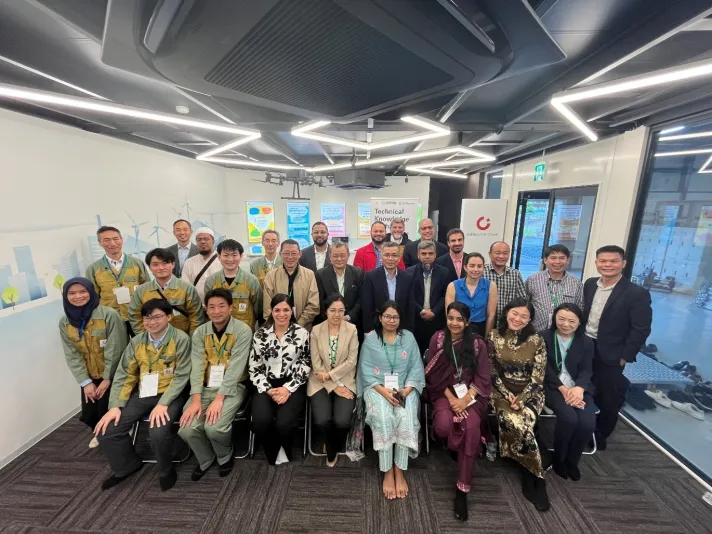
From Lessons to Action
On the final day, each country presented an action plan reflecting both the shared lessons and their own priorities. Vietnam is planning to strengthen its transmission network and introduce AI-based predictive maintenance. Bangladesh is designing a drone inspection program for its transmission towers. Bhutan is launching a grid modernization initiative with a battery storage pilot and a new power market framework. The Dominican Republic is building an inter-ministerial contingency system for the energy sector, reflecting one of the exchange’s broader lessons: resilience depends as much on data sharing, transparency, and coordination across agencies as it does on technology or equipment.
The five-day exchange offered more than technical lessons. It showed that resilient power systems depend not only on equipment, but on institutions, coordination and the practice of turning each shock into practical reform. For four countries facing very different hazards, Japan offered a concrete picture of what a resilient power system can look like, and a network of partners with whom they can continue building resilient systems.