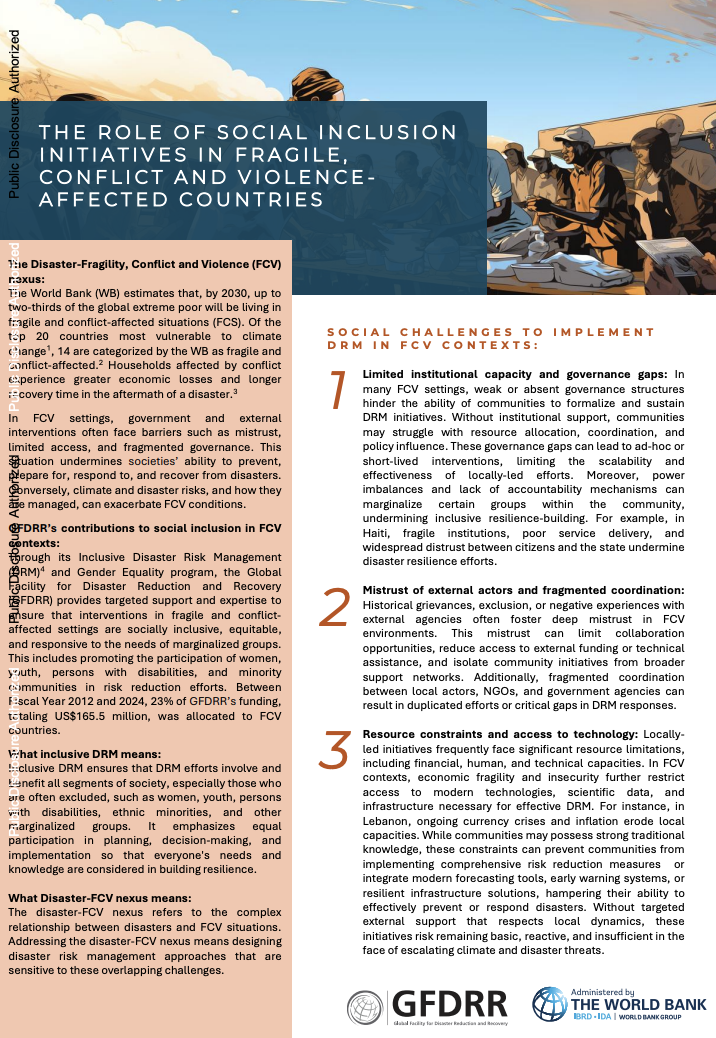
This factsheet underscores the importance of social inclusion in Disaster Risk Management (DRM) across Fragile, Conflict, and Violence (FCV) contexts, where the World Bank projects that up to two-thirds of the global extreme poor may live by 2030. Its objective is to guide equitable, locally responsive DRM interventions that address the intersecting disaster–FCV nexus, in which conflict magnifies disaster impacts and deepens vulnerability for marginalized groups. Key portfolio insights show that the Global Facility for Disaster Reduction and Recovery (GFDRR) allocated 165.5 million dollars, 23 percent of its funding, to FCV countries between FY2012 and FY2024 to advance inclusive DRM. Persistent challenges include constrained institutional capacity, limited trust in external actors, severe resource and data gaps, and difficulties integrating modern technologies with traditional knowledge systems. The factsheet recommends four complementary, locally led strategies: enabling community involvement in planning; targeted capacity building for vulnerable groups and local institutions; empowering communities through ownership mechanisms; and inclusive strategic integration that embeds social inclusion across DRM policies and operations. Case examples from Myanmar, Haiti, Republic of the Congo, and Yemen illustrate how these measures can strengthen trust, leverage local knowledge, and improve the effectiveness and sustainability of DRM in complex FCV environments.

The Role of Social Inclusion Initiatives in Fragile, Conflict, and Violence-Affected Countries
December 17, 2025