
STORY HIGHLIGHTS
- As countries strengthen climate resilience within broader development agendas, including sectors supporting green jobs and tourism, interest in nature-based solutions (NBS) has grown, yet translating that interest into scaled implementation remains constrained by limited capacity.
- The Nature-Based Solutions Training Program supports World Bank-financed projects by strengthening the capacity of government agencies and practitioners to identify solutions to some of their most pressing resilience challenges, and to plan, design, implement, and sustainably manage NBS within development operations.
- Since 2024, customized NBS training courses delivered in Azerbaijan, Jamaica, Kenya, and Tanzania have enhanced institutional readiness and supported the translation of NBS concepts into practical solutions for World Bank-financed development projects.
From cities to coastlines, countries around the world are working to integrate NBS into development planning and climate resilience strategies. From flood protection and land restoration to urban cooling and biodiversity enhancement, NBS are increasingly recognized as approaches that can mitigate climate risks while supporting resilient infrastructure and sustainable development. Yet, despite growing interest, many stakeholders lack the technical capacity to effectively plan, design, implement, and sustainably manage NBS. Limited access to applied, context-specific training constrains the integration of NBS into project preparation and development processes across sectors.
To respond to this need, the Global Facility for Disaster Reduction and Recovery (GFDRR) developed the Nature-Based Solutions Training Program, which supports the World Bank, its clients, and development partners to identify NBS opportunities and strengthen institutional capacity to integrate NBS into development projects.
Turning Ambition into Practical Action
Designed specifically for World Bank-financed projects and structured with a flexible, modular framework, the NBS Training Program combines cross-cutting and NBS-specific modules tailored to local needs. Cross-cutting thematic content includes:
- An introduction to NBS;
- Enabling conditions and policies for NBS;
- Participatory methods;
- Economics and finance considerations;
- Spatial analysis tools;
- Context-specific design approaches; and
- Management and monitoring of NBS.
Specialized modules address NBS application for cities, land restoration and landscape resilience, agriculture, mountainous and hilly landscapes, integrated water resource management, coastal and marine resilience, and arid landscapes and drought resilience. By adapting content to local priorities and climate risks, the Program strengthens the enabling environment for NBS and supports their integration into development planning and project preparation processes.
The training builds on global best practices and World Bank expertise, drawing from case studies, analytical tools, and recent publications, including the Catalogue of Nature Based Solutions for Coastal Resilience and Unlocking Nature for Disaster Resilience: A Policy Guide to Enable Nature-Based Solutions. Through participatory exercises, site visits, and real-world case discussions, participants translate global knowledge into locally relevant implementation pathways.
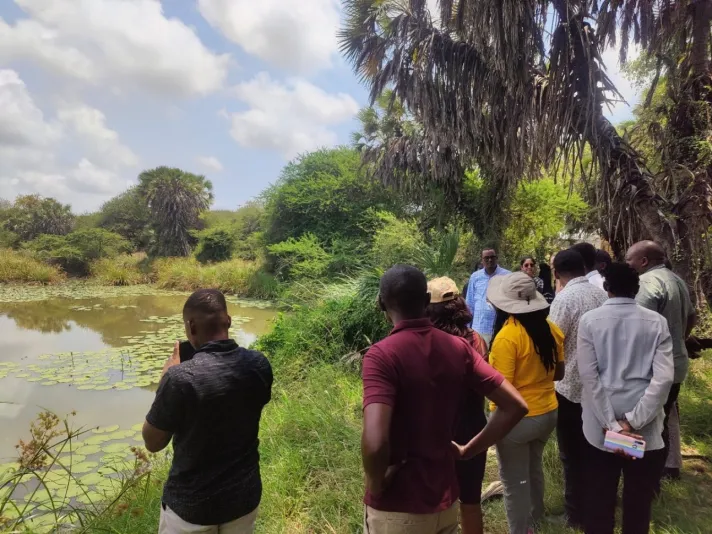
NBS Training Course for climate, urban, and flood resilience in Mombasa, Kenya. Source: ©World Bank
A Structured Process for Tailored Course Delivery
Each training follows a structured process, beginning with a request from World Bank country teams, followed by a training needs assessment to determine the participants. Technical experts are then identified and onboarded to customize lessons, materials, and tools to the local context. Course logistics, including venues and site visits, are finalized in coordination with local counterparts, and trainings are delivered on site over two to five days. Daily feedback from participants informs continuous refinement of the program in real-time to ensure core concepts are understood and optimal learning.
Training in Action
Since 2024, GFDRR has delivered customized NBS training courses in Azerbaijan, Jamaica, Kenya and Tanzania, strengthening institutional readiness and advancing practical application of nature-based approaches to resilience challenges.
- Baku, Azerbaijan (December 2–4, 2025) – GFDRR hosted a three-day Deep Dive NBS Training Course tailored to Baku’s climate and historical context. The training combined foundational NBS concepts with technical sessions on wastewater treatment and landscape restoration. Through hands-on design exercises, participants explored how NBS could address local environmental pressures and concluded with reflections on next steps to strengthen implementation capacity.
- Kingston, Jamaica (May 15–17, 2024) – The course addressed NBS for climate, urban, and coastal resilience in the context of Kingston’s unique challenges. Presentations and case discussions were complemented by a walking tour to explore NBS opportunities. Through brainstorming and visioning sessions, participants identified practical solutions, clarified stakeholder roles, and explored pathways to advance implementation.
- Mombasa, Kenya (October 22–24, 2025) – An Applied NBS Training Course provided foundational knowledge with focused sessions on urban forests, mangroves, wetlands, and riparian areas. Collaborative design work and long-term planning exercises supported the integration of NBS into urban development, flood management, and climate resilience efforts along Kenya’s coast.
- Zanzibar Town, Tanzania (August 26–28, 2025) – The training explored NBS for flood risk reduction and urban resilience, focusing on the restoration and revitalization of the Mwantenga and Ziwa ponds. Site visits and group activities enabled participants to assess local conditions and refine context-specific approaches.
Across locations, the emphasis has remained consistent: equipping practitioners with the skills and confidence needed to translate NBS ambition into practical, implementable actions aligned with development goals.
“'The knowledge I acquired is useful in my work environment. The program helped align different stakeholders across our administration to acknowledge the problem of our city and agree on the best NBS practices”
-Training Course Participant
As countries continue to emphasize the need to strengthen climate resilience within broader development agendas, building the institutional capacity to effectively plan, design, implement, and sustainably manage NBS remains essential. Through applied learning and tailored engagement, the Nature-Based Solutions Training Program helps ensure that growing interest in NBS translates into sustainable implementation within World Bank–financed projects.
Interested in learning more about the NBS Training Program? Visit our website.