by Akiko Toya, Diana Rubiano, and Rodrigo Donoso
Ecuador is facing compounding risks from climate-related shocks, natural hazards, and public health threats. In November 2024, Ecuador faced its worst drought in 60 years, prompting a National Emergency as power outages stretched up to 14 hours a day. The economic toll was staggering — industrial losses alone reached an estimated $7.5 billion. Past disasters have also taken a heavy toll. The 2016 earthquake, for example, caused billions in reconstruction needs, and the COVID-19 pandemic resulted in economic losses equivalent to 6% of GDP. These repeated shocks highlight the importance of investing in resilience to protect development gains and strengthen national preparedness.
The enactment of Ecuador’s first Disaster Risk Management (DRM) Law and its implementing regulations in 2024 marked a historic milestone after more than a decade of policy development and institutional dialogue. The law established a binding, cross-sectoral framework that formalizes DRM mandates across sectoral ministries and subnational governments. It aims to improve disaster and climate resilience by addressing long-standing gaps in coordination, implementation, and institutional capacity. While the law provides a solid foundation, implementation remains challenging, particularly at the sectoral and local levels where capacity gaps persist.
Building on these reforms, the World Bank approved $200 million DRM Development Policy Financing with a Catastrophe Deferred Drawdown Option (Cat-DDO) on November 26, 2025. This is Ecuador’s first Cat-DDO, and its approval represents a significant step in strengthening the country’s financial preparedness for disasters. This instrument complements the government’s broader DRM agenda and reinforces the policy and institutional measures established through the new DRM Law. It is also one of only two contingent financing instruments currently available to Ecuador, alongside the Inter-American Development Bank’s (IDB) $400 million contingent loan for natural disaster and public health emergencies.
Ecuador’s disaster risk financing system is built around three layers: basic budget resources, contingent credit, and risk-transfer tools. The Cat-DDO strengthens the second layer by providing rapid, flexible financing for moderate to severe events, an important function given the country’s limited reserves and still-developing risk-transfer mechanisms such as insurance and catastrophe bonds.
In a context where Ecuador relies heavily on emergency loans and budget reallocations after disasters, the Cat-DDO helps close a significant protection gap by providing rapid and reliable liquidity in the event of natural, climate-related, or public health shocks. The government is also developing a National Disaster Risk Financing Strategy with World Bank support, funded through the Global Facility for Disaster Reduction and Recovery (GFDRR), building on technical collaboration initiated in 2021. The Cat-DDO directly contributes to this broader strategy and is designed to leverage the Rapid Response Option to address imminent and compounding threats.
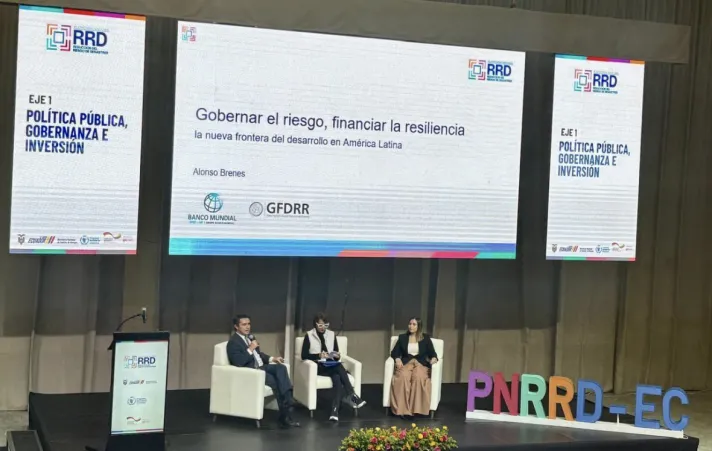
A session on DRM organized at the National Platform for Disaster Risk Reduction
Investing in Resilience for Sustainable Development
In parallel with the Cat-DDO, the World Bank has provided technical assistance financed by GFDRR, to support the National Secretariat for Risk Management in updating the National Disaster Risk Reduction Plan — the country’s main strategic instrument for reducing disaster and climate risk. This support focused on improving the Plan’s structure, strengthening internal coherence, and introducing a SMART indicator framework (specific, measurable, achievable, relevant, and time-bound) to monitor progress more effectively.
The importance of stronger institutional and financial coordination was highlighted during the National Platform for Disaster Risk Reduction held in Quito on October 16-17, 2025. Representatives from public institutions, the private sector, and civil society underscored the strategic role of investing in resilience and the need to align financial protection mechanisms with institutional strengthening efforts.
The World Bank’s collaboration with Ecuador demonstrates how institutional reforms, technical assistance and financial preparedness can work hand in hand to safeguard fiscal stability, protect development gains, and enhance long-term resilience. Continued efforts to enhance the capacities of the decentralized DRM system and subnational governments will be essential to ensure that national policy translates into concrete local action. With the Cat-DDO, Ecuador reaffirms its commitment to building a more resilient, inclusive, and sustainable future.