
By Sachi Suzuki and Swarna Kazi
Bangladesh is increasingly exposed to complex disaster risks, driven by climate change, rapid urbanization, and evolving socio-economic challenges. Recognizing these challenges, the Government of Bangladesh has gradually shifted their focus from reactive disaster response to proactive investments in disaster preparedness.
But what does it take for Bangladesh to be more prepared?
In July 2025, the World Bank facilitated a multi-sectoral technical knowledge exchange between Bangladesh and Japan, supported by World Bank’s Tokyo Disaster Risk Management (DRM) Hub. This initiative convened technical officers from Bangladeshi government organizations with a shared mandate to build disaster resilience in cities: the Capital Development Authority, the Fire Service and Civil Defense, the Water Development Board, the Local Government Engineering Department, the Department of Disaster Management, the Dhaka North City Corporation, and the Dhaka South City Corporation. The knowledge exchange focused on two critical themes: resilient infrastructure and emergency preparedness and response.
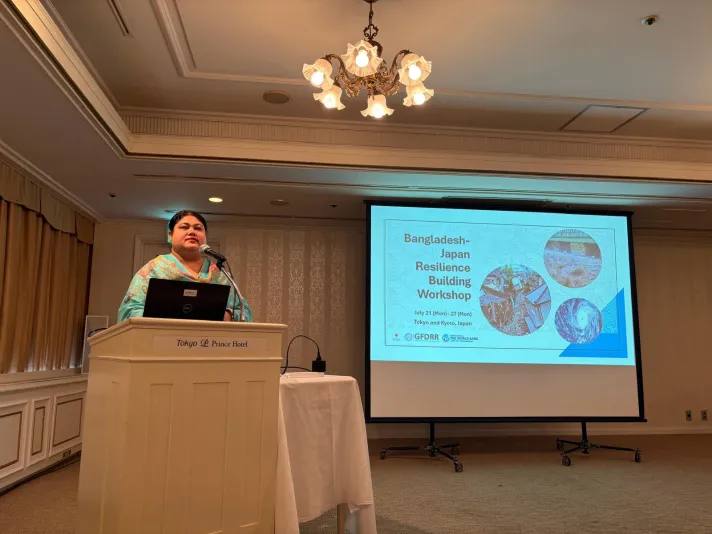
Kick-off meeting ©World Bank
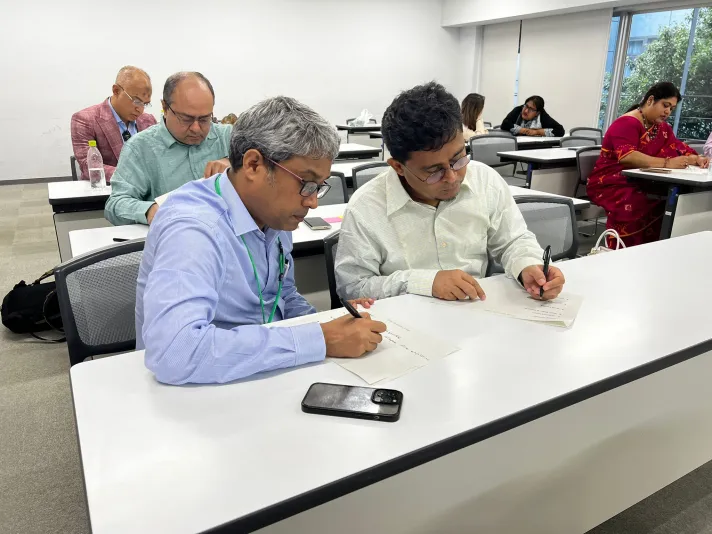
Multi-hazard disaster simulation exercise at the University Tokyo ©World Bank
Building Resilient Infrastructure to Address Urbanization Challenges
Infrastructure is a vital pre-disaster investment that safeguards lives and property. In Bangladesh, strengthening operation and maintenance practices and exploring innovative solutions could maximize limited fiscal resources. Good practices from Tokyo and Kyoto in Japan demonstrated how long-term planning, rigorous maintenance, and resilience integrated into every stage of building design can deliver lasting impact.
Participants visited two key infrastructures in Japan’s densely populated river basins: the Metropolitan Outer Area Underground Discharge Channel and the Amagase Dam.
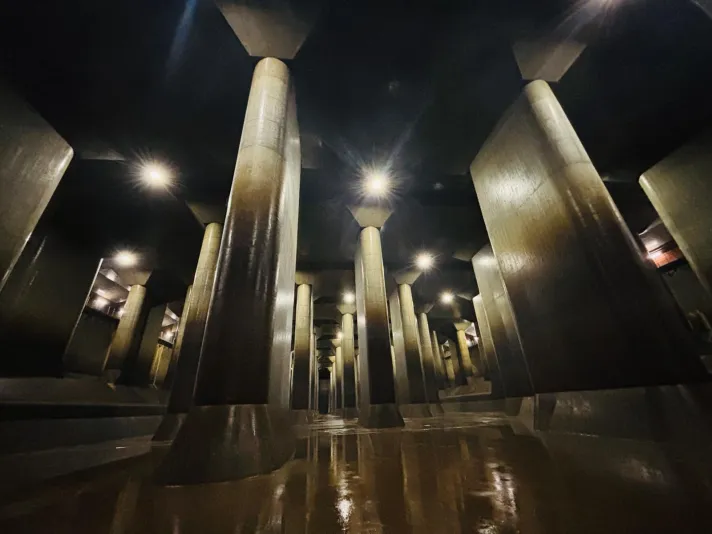
The Metropolitan Outer Area Underground Discharge Channel ©World Bank
Tokyo’s rapid urban expansion once caused repeated flooding. The conversion of agricultural fields led to the loss of natural flood mitigation and a greater concentration of people and assets in vulnerable zones. In response, the Tokyo Metropolitan Outer Area Underground Discharge Channel was developed as an underground floodway that diverts floodwaters from small and medium sized rivers underground and channels them through tunnels into the Edogawa river, which has a sufficient capacity to absorb excess water. Since its partial operation in 2002, the Channel has reduced flood damage by over $1 billion and decreased the number of affected houses by 90%. This engineering solution exemplifies how targeted investments can address urban flooding.
In Kyoto, the Amagase Dam was built as the very first dam on one of the biggest rivers in west Japan, Yamatogawa river and Yodogawa river. It was built in 1964 for flood management, water supply, and energy generation. Today, the 60-year-old Amagase Dam continues to function effectively thanks to Japanese good practice in operations and maintenance, covering regular inspection, ongoing sediment removal, and infrastructure upgrades such as the installation of a new tunnel spillway to enhance discharge capacity.
"I learned the value of investing in regular maintenance and proper care of our infrastructure and equipment, which helps extend their lifespan and ensures everything runs efficiently." – Mr Javed Karim, Chief Engineer, Local Government Engineering Department (LGED) and Project Director of World Bank financed projects.
The Tokyo Metropolitan Government also shared decades-long efforts in fire-proofing and seismic retrofitting, supported by building inspections, financial incentives, and strategic land acquisition. Today, over 65% of neighborhoods are fire-resistant, nearing the 70% target, and 94% of critical buildings have been equipped with earthquake resistance measures, reflecting the city’s strong commitment to urban resilience and public safety.
Emergency Preparedness through Information and Training
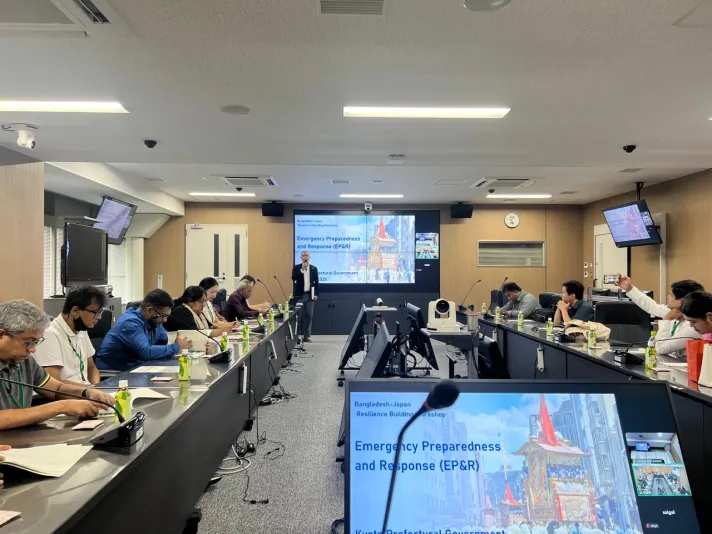
Emergency Operation Center at Kyoto Prefecture Government ©World Bank
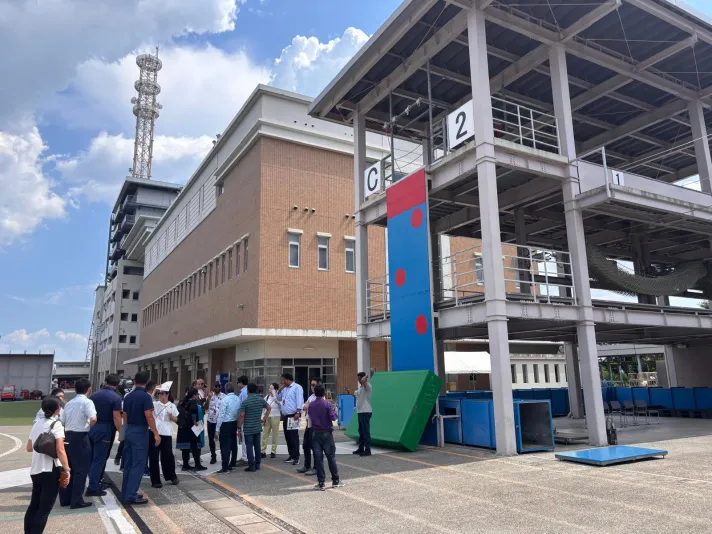
Kyoto City Fire Training Center ©World Bank
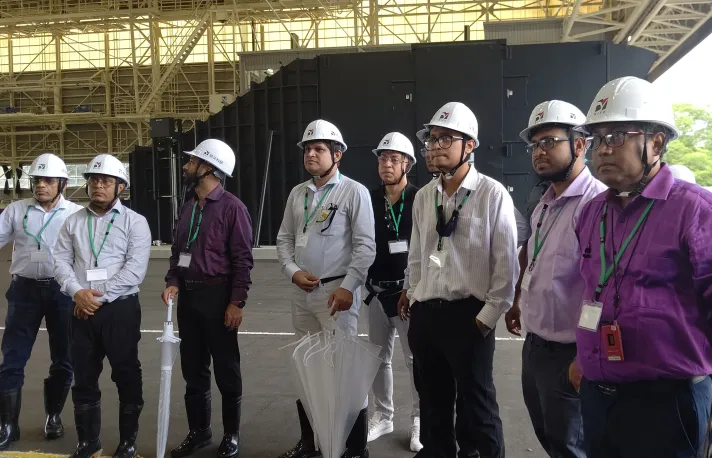
Large-scale rainfall experiment facilities at the National Research Institute for Earth Science and Disaster Resilience ©World Bank
Effective emergency management relies on robust information systems and skilled personnel. The Emergency Operations Center in Kyoto Prefecture demonstrated a comprehensive approach to collecting and sharing data on hazards, logistics, damage assessments, resource allocation, and shelter locations—supported by legal and regulatory frameworks that ensure coordination and quick response.
Both Japan and Bangladesh face ongoing challenges in inter-agency information sharing, training, and staffing. Japanese institutions have addressed these with innovative solutions. At the National Research Institute for Earth Science and Disaster Prevention (NIED), a dedicated Information Support Team deploys officers to affected local governments to enable real-time disaster information and analysis. In Kyoto, the Kyoto Prefectural government provides on-site data input support and conducts annual large-scale joint exercises, while the Kyoto City Fire Training Center offers comprehensive training for firefighters and volunteer organizations.
"Municipality-centered disaster risk management has faced increasing challenges due to more frequent and severe disasters. Greater support from prefectural, national, and non-affected local governments is essential." - Mr. Katsuya Furuhashi, Division Chief, Kyoto Prefecture Crisis Management Department, Nuclear Disaster Prevention Division
Shared Lessons
This knowledge exchange inspired Bangladeshi participants to adopt new technologies and tools, and appreciate the preparedness mindset at the core of Japan’s disaster risk management approach. The participants valued Japan’s integrated system of research, education, training, application, and review, which underpins its high-level of disaster preparedness. Participants also recognized that resilience is a shared responsibility across ministries, agencies, and communities, and expressed appreciation for the Japan-World Bank DRM Program’s knowledge leadership in emergency preparedness. Participants expressed their commitment to develop a new generation of resilient projects based on the lessons learned from Japan in this knowledge exchange.
“I was so impressed by how passionate the participants were. We were motivated by their sincere attitude to try to be better and serve for community” – Mr Noburu Yoshikawa, Public Relations Section Chief, General Affairs Section, Kyoto City Fire Department
This knowledge exchange has been made possible through the financial support of the Government of Japan, via the Japan–World Bank Program for Mainstreaming Disaster Risk Management in Developing Countries, which is managed by the Global Facility for Disaster Reduction and Recovery (GFDRR).