

News
There are five things that people working to develop resilience programmes and policies can do to counter the looming existential threat posed by Trump if they become more savvy political operators.
When countries rebuild stronger, faster and more inclusively after natural disasters they can reduce the impact on people’s livelihoods and well-being by as much as 31 percent, potentially cutting global average losses from $555 billion to $382 billion per year. That’s the conclusion of a new report from the World Bank and the Global Facility for Disaster Reduction and Recovery (GFDRR).
The World Bank’s Board of Executive Directors today approved US$7 million in financing to Seychelles to help the country better cope with extreme natural events such as floods, mud slides, or tsunamis.
Cities around the world are failing to plan for fast-increasing risks from extreme weather and other hazards, particularly as population growth and surging migration put more people in the path of those threats.
The final of the Women Entrepreneurs of the MENA region (WeMENA) contest, a regional initiative launched by the World Bank, and supported by the Global Facility for Disaster Reduction and Recovery (GFDRR), selected four winners.
The World Bank has released US$496.25 million to support the Philippine government’s efforts to hasten recovery, rehabilitation, and reconstruction in areas battered by Typhoon Ompong (internationally known as Mangkhut) in mid-September this year.
The Global Facility for Disaster Reduction and Recovery has developed a diagnostic tool called CityStrength to help cities identify areas of weakness and the investments and institutional measures necessary to address them.
By 2050 there will be $158 trillion in assets at risk from flooding alone — not to mention 1.3 billion people at risk — driven largely by climate change and urbanization.
The World Bank approved US$50 million for the Strengthening Critical Infrastructure Against Natural Hazards Project in Tajikistan.
[De L'Agora, quotidien independant d'information et d'analyse de la République centrafricaine]
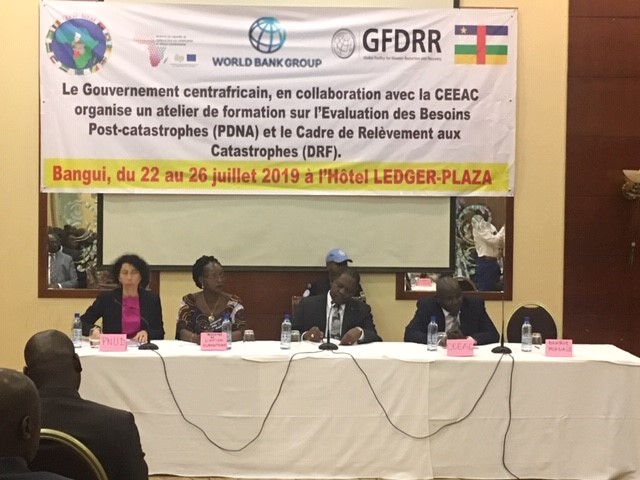
Le gouvernement centrafricain en collaboration avec la CEEAC organise à Bangui un atelier de formation sur l'évaluation des besoins post-catastrophes (PDNA) et le cadre de relèvement aux catastrophes (DRF) à l'hotel Ledger-Plaza du 22 au 26 juillet 2019. La cérémonie d'ouverture de cet atelier de formation a été présidée hier par le Premier Ministre, Chef du gouvernement Firmin NGREBADA, assisté du Ministre de l'Action Humanitaire avec les représentants des organisations telles que: Programme des Nations Unies pour le développement, de la Banque Mondiale et de celui de la CEEAC.
This response was generated with the assistance of artificial intelligence, and it may contain errors or reflect biases. Please verify all information before use.