When disaster strikes, preparedness is measured not only in lives saved, but also in how quickly communities, services, jobs and local economies can keep functioning. Strong emergency preparedness and response systems help protect people, safeguard critical infrastructure, reduce disruptions to livelihoods, and support faster recovery.
The lesson became vividly clear on April 20, 2026, the first day of the World Bank and the Global Facility for Disaster Reduction and Recovery (GFDRR) Practitioners Academy on Emergency Preparedness (EP&R) in Japan. More than 40 disaster risk management experts from 15 countries gathered for a week of case studies, simulations, and peer exchange. But as the Academy began, a magnitude 7.5 earthquake struck off the northeast coast of Japan. Within seconds, tsunami alerts were issued, systems were activated, and public broadcasts provided clear information on risks and evacuation guidance.
For participants, the experience brought the Academy’s purpose into sharp focus. What had been designed as a learning exercise became a real-time demonstration of how preparedness, early warning, and coordination can protect lives and limit disruption when every minute matters.
Hosted by the GFDRR’s World Bank Tokyo Disaster Risk Management Hub and jointly organized by the EP&R team, the Practitioners Academy took place from April 20 to 24 in Tokyo and Sendai. Delegations from Albania, Angola, Cabo Verde, Cambodia, Croatia, Ecuador, Ethiopia, Guinea, Haiti, Honduras, India, Mongolia, Nigeria, the Republic of Congo and Tanzania came together to strengthen emergency preparedness and response systems and bridge the gap between policy and practice.
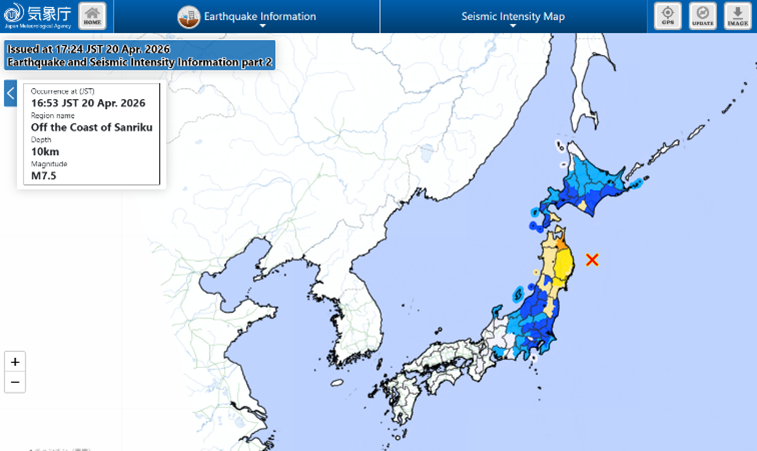
Interactive map issued by the Japanese Meteorological Agency (JMA) following the 7.5 earthquake on April 20, 2026. Accessible at: https://www.jma.go.jp/bosai/map.html#5/40.308/138.085/&elem=int&contents=earthquake_map&lang=en
Baseline Assessments: Moving Beyond Assumptions
The experience reinforced one of the Academy’s central themes: effective emergency response does not begin during a crisis. It depends on systems, institutions, and coordination mechanisms that are already in place and ready to function when disaster strikes.
That is why rapid EP&R baseline assessments are so important. They give countries practical instruments for decision-making —helping countries identify gaps, prioritize investments, and engage key stakeholders such as Ministries of Finance and development partners.
Participants explored a range of World Bank and GFDRR tools, from rapid diagnostics, comprehensive Ready2Respond Assessments, and multi-sectoral Crisis Preparedness Gap Analysis. Across countries, a common pattern emerged: while legal and institutional frameworks are often relatively strong, operational readiness remains weak. Facilities, personnel, and financial preparedness were repeatedly identified as critical gaps. This insight challenges a common assumption —that passing laws and establishing institutions is sufficient. Systems that look robust on paper often struggle under real-world conditions.
Country experiences brought this point into sharp focus. In Cambodia, assessments confirmed strong legislative frameworks while revealing significant shortcomings in coordination, resourcing, and implementation. These findings directly informed new initiatives, including a social protection framework, a crisis response fund, and an early warning roadmap. In Nigeria, state-level assessments exposed fragmentation across response systems, shifting discussions away from institutional blame toward practical improvements.
As one participant put it: “A strong law without a functional facility is just a promise we can't keep. We must align our physical assets with our institutional goals.”
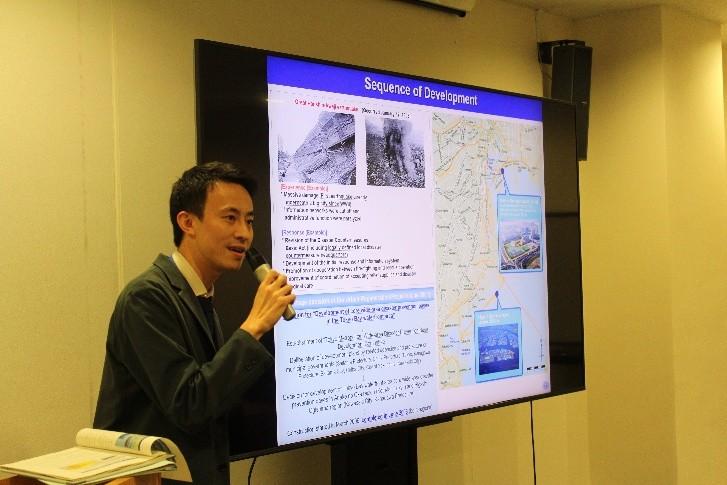
Presentation during the EP&R Learning Academy on the Japanese EWS system. Image accessible on the event Flickr page
From Forecasts to Action: Lessons from Japan
The April 20 earthquake did more than underscore the importance of assessing EP&R system preparedness. It showcased how Japan connects real-time observation, forecasting and response decision-making into a seamless process.
Through technical sessions and field visits, participants saw how advanced technologies —such as the information sharing system SOBO-Web, satellite monitoring, nationwide sensor networks, and AI-driven forecasting models— are embedded within clear institutional frameworks. They also learned how Japan’s approach is reinforced by household preparedness, regular public drills, and targeted measures to protect vulnerable groups, including elderly persons, persons with disabilities, and isolated communities. During the earthquake, this clarity was evident. Alerts were issued immediately, data was aggregated across agencies, and authorities were able to assess the situation quickly. The system enabled a proportional response, confirming that there were no casualties and avoiding unnecessary escalation.
For many participants, this was a powerful lesson. Early warning systems are often viewed as technical challenges — focused on improving forecasting accuracy. But Japan’s experience demonstrates that effectiveness depends just as much on usability, trust, and coordination.
Field visits deepened these insights. In Tokyo, participants visited an operation command center, including a 72-hour earthquake simulation exhibition tour. Presentations from the Japanese Cabinet Office, the Japanese Meteorological Agency (JMA), and the Japanese Ministry of Land, Infrastructure, Transport and Tourism (MLIT) illustrated how early warning systems and coordination mechanisms function in practice. In Sendai, field visits included the Sendai Nagamachi Future Co-Creation Center, a public-private partnership for emergency management, and joined sessions hosted by Tohoku University on municipal preparedness, inclusion, risk communication, and wildfire risk management.
Preparedness for the Long Term
For countries looking to strengthen their own systems, the lesson is not to replicate Japan’s technology wholesale, but to adopt its principles: define essential information needs, establish clear roles and responsibilities, and ensure that data flows efficiently between institutions, communities and the private sector. Equally important is institutionalization. Japan’s systems are underpinned by strong legal frameworks, well-defined mandates, and sustained investment. Technology alone is not enough; it must be supported by governance, accountability, and trust. Participants were encouraged to start small by building centralized data platforms, linking alerts to action, and gradually expanding system capabilities. The goal is not perfection, but progress. In the end, the Academy’s most powerful lesson was simple: preparedness is not a theoretical exercise. It is a continuous process of learning, testing, and improving. And sometimes, reality arrives without warning.